Back To Blog
 Smart home demand can make a weak product look attractive. A camera sells for several times the factory price, a lock looks differentiated, and an app turns an ordinary sensor into “AI.” Then the first batch arrives. Buyers cannot connect it to their routers, the cloud trial expires, one platform exposes fewer features than another, and support tickets consume the profit that appeared on the quotation.
The global smart-home-device market is estimated at $179.73 billion in 2026. That number includes televisions, entertainment products, appliances, lighting, security, and other categories that behave nothing alike. It proves demand exists; it does not tell an ecommerce seller what to stock.
I would enter this market through a narrow household outcome, not a long device list. The strongest starting position sits where a customer can understand the benefit in one sentence, install the product without a technician, and keep using its core function even if a cloud service or platform changes.
Where the margin actually sits
- Start with one clear household outcome, not a broad connected-device catalog.
- Model support, returns, cloud, compliance, and updates before comparing markup.
- Prefer sensor-led systems when you need a lower-failure, expandable first assortment.
- Treat service ownership and market access as pass-or-fail buying gates.
Smart home is a bundle of different markets
Forty-five percent of US internet households had at least one smart-home device in 2024, while 18% had six or more. That installed base matters because the next sale is often an addition to an existing home, not a homeowner's first experiment.
Four demand engines shape the category
The category has four separate demand engines: safety, lower utility costs, convenience, and outsourced household work. They create different buying behavior and very different after-sale costs.
| Product group | Customer outcome | Wholesale attraction | Margin threat |
|---|---|---|---|
| Plugs, bulbs, switches | Remote control and simple automation | Low freight per unit; easy bundles | Price comparison, router setup, electrical variants |
| Cameras, doorbells, locks | Security and remote access | Higher selling price; accessory and subscription potential | Privacy, cloud dependence, false alerts, installation support |
| Leak, climate, air-quality, and energy sensors | Prevent damage or reduce waste | Outcome-led bundles; room for private label | Calibration, alert reliability, battery performance |
| Robot vacuums and connected appliances | Replace recurring household labor | High order value and visible features | Bulky returns, spare parts, batteries, repairs, firmware |
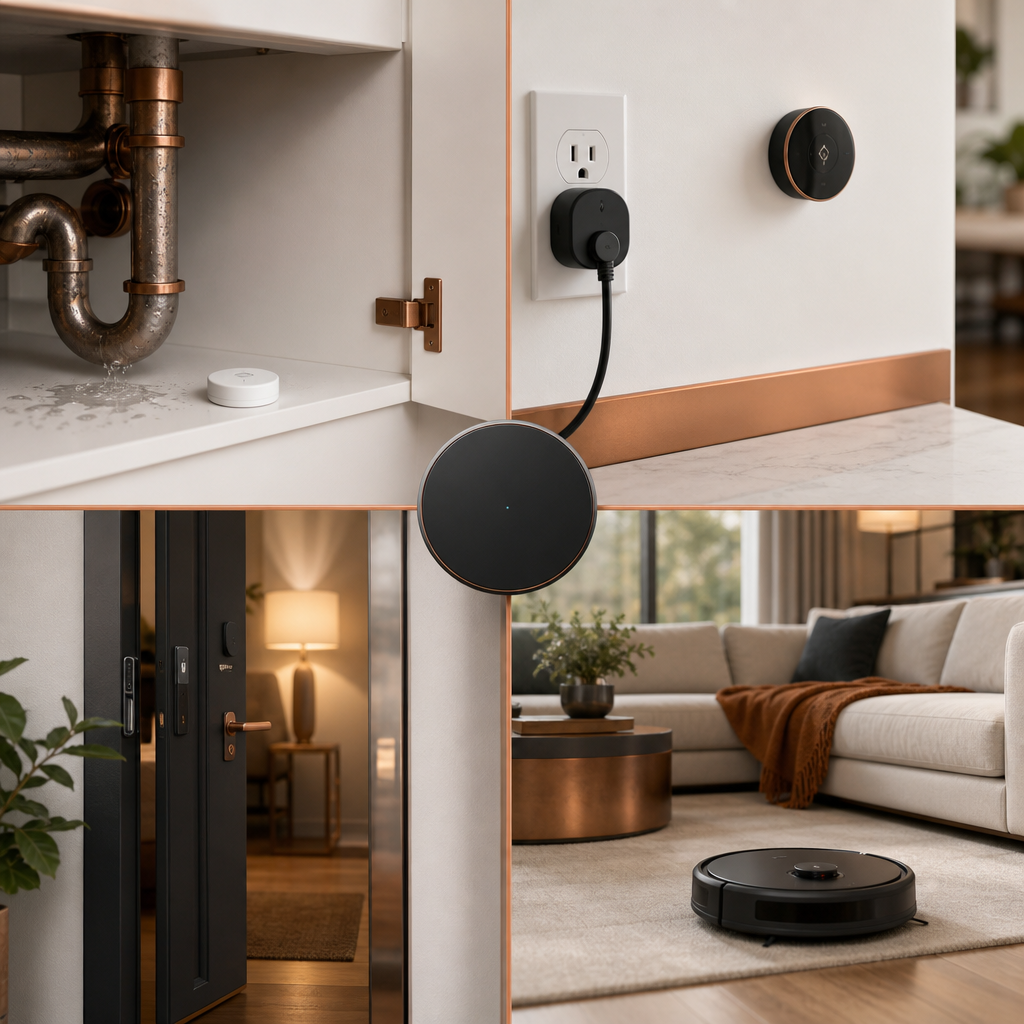
Safety and security ranked as the leading smart-home priority in a 2025 US and Canadian survey. The same study found interest in real-time energy monitoring, automated energy optimization, and water monitoring. These signals favor products that prevent a visible loss or expose a measurable cost. “Know before the pipe floods” is easier to sell than “make your home smarter.”
Start by naming the household event your product detects, prevents, or automates. If the answer is only “convenience,” expect the listing to compete harder on price.
Margin appears after support, not before it
Supplier-to-retail markup is the wrong measure for a connected product. Use contribution margin after the costs created by connectivity:
Put connectivity into the cost sheet
Contribution margin formula
Contribution margin per order = selling price − landed product cost − marketplace and payment fees − fulfillment − returns reserve − support cost − cloud and app cost − compliance amortization
Consider an illustrative device that sells for $49. The landed product costs $16, marketplace and payment fees take $8, fulfillment costs $6, and advertising takes $7. The apparent $33 spread has already fallen to $12. Set aside $3 for returns and replacements, $2 for support, and $1 for cloud, certification, and update costs, and only $6 remains. These are teaching assumptions, not a supplier quote or industry average.
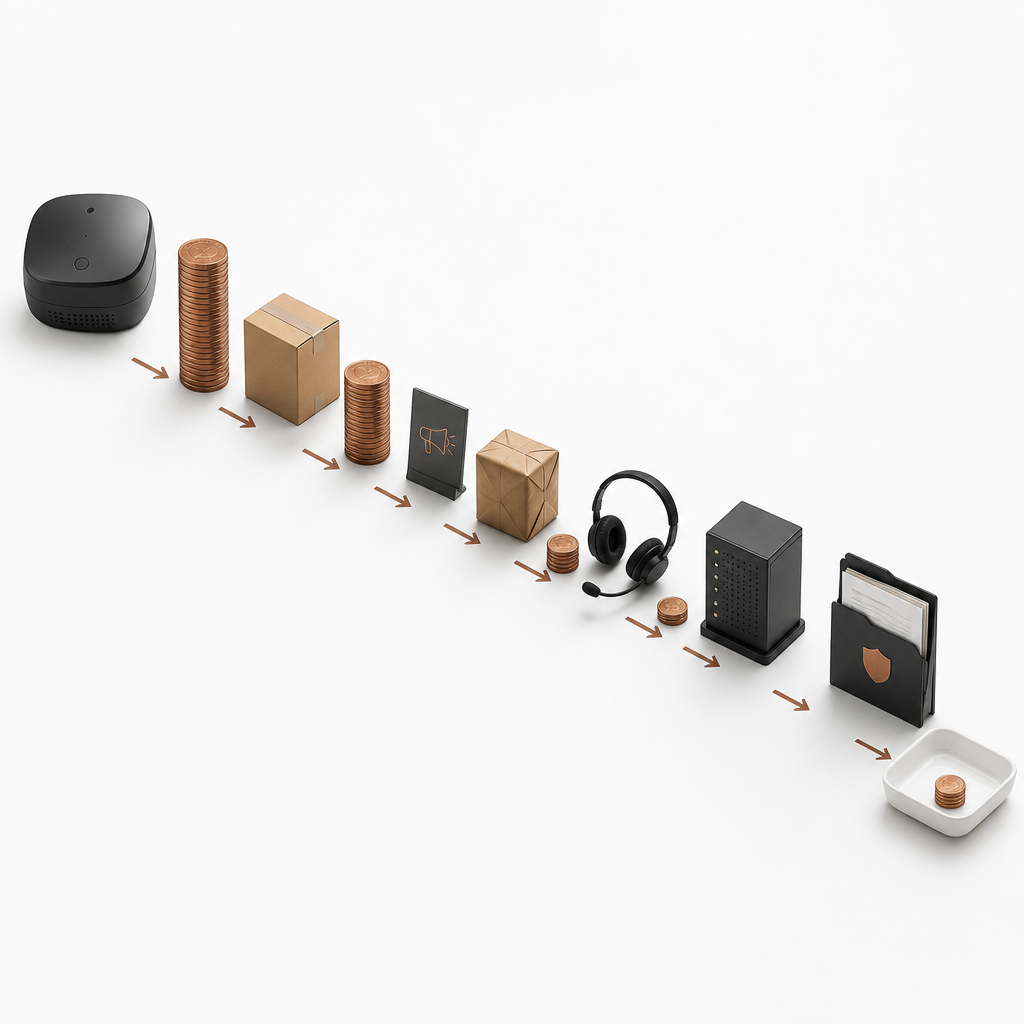
Now compare a three-sensor kit at the same selling price. It may use the same app, one package, one support conversation, and no motor or camera. If the kit makes the benefit clearer while lowering failure points, its smaller markup can produce more contribution profit.
Margin check: Run this worksheet for the entire order, not one perfect unit. A smart-home SKU that needs ten minutes of human support on every fifth order has created a labor subscription for the seller.
The best entry point is usually a sensor-led system
For a new ecommerce seller, I prefer a sensor-led kit over a stand-alone “hero” device. Water-leak sensors, door and window sensors, temperature and humidity monitors, and compatible plugs can form a system without forcing the seller to begin with locks, cameras, compressors, or motors.
Expand the outcome, not the feature list
The commercial advantage comes from expansion. One starter kit earns the first order; another sensor adds a room; a siren or valve controller raises the basket; replacement batteries and mounting accessories reduce friction. The customer is buying a result that improves as the system grows.
This is not a claim that sensors always carry the highest gross margin. They usually carry fewer mechanical failure modes and a more manageable replacement path. They also let a seller test which outcome resonates—water damage, security, energy, or comfort—before committing working capital to a broad catalog.
Commodity bulbs and plugs can still work when they are part of that outcome. A plug sold as “Wi-Fi control” enters a crowded comparison page. The same hardware paired with an energy monitor and a tested automation recipe has a job. The bundle, onboarding, and support content create the distinction.
Use fast testing and flexible supply to validate one outcome at a time. A large assortment launched under one app produces plenty of sales data but little clarity about why customers bought.
High-ticket devices require a service business
Cameras, locks, robot vacuums, and major appliances can generate more revenue per order. They also turn the seller into an operator of replacements, spare parts, firmware, and customer access.
Price the whole service layer
A camera is not only a lens and radio. The product includes the mobile app, account recovery, notification delivery, video storage, privacy controls, and the server that may still need to work years after the sale. NIST treats the device, companion app, specialty hardware, and backend services as one consumer IoT product for cybersecurity purposes. Buyers experience them the same way: if any one layer fails, “the camera does not work.”
A smart lock raises the stakes because software can affect physical access. A robot vacuum adds wheels, brushes, sensors, a battery, a charging dock, maps, consumables, and bulky reverse logistics. These are good categories for a company with service infrastructure. They are poor experiments for a seller whose returns process ends with a refund.
Before you order
Before ordering a high-ticket device, obtain the spare-parts list, repair decision tree, app ownership terms, cloud-cost schedule, firmware responsibility, and end-of-support policy. If the supplier answers only with a warranty period, the operating model is incomplete.
Matter lowers friction but does not remove testing
Matter has become a meaningful buying filter because it gives compatible devices a common application layer across major ecosystems. Matter 1.6, released in June 2026, improves commissioning, multi-ecosystem management, thermostat controls, device status, and security-sensor history. NFC-based commissioning can make installed products easier to provision, while Joint Fabric creates a path for several authorized controllers to manage one network.
Test the claim on production hardware
Certification still does not mean every feature will appear identically on every platform. Device makers and ecosystems adopt new specification features on their own schedules. Wi-Fi, Thread, and Bluetooth also play different transport or setup roles; a Matter logo does not fix a weak antenna, a poor app, or an underpowered border router.
Test the exact production model on the current versions of the ecosystems named on the package. Complete setup, sharing, reset, offline recovery, router replacement, firmware update, and account deletion. Record the number of steps and every point where a buyer could stop. Product-page compatibility claims should match that test matrix, not the chipset brochure.
Cybersecurity is now part of landed cost
Connected-product compliance no longer ends with radio and electrical paperwork. The seller needs a market-specific file that covers the radio, product safety, privacy, and cybersecurity lifecycle.
Separate mandatory access from voluntary trust marks
In the United States, Wi-Fi and Bluetooth transmitters generally need FCC equipment authorization before they are imported or marketed. The US Cyber Trust Mark adds a voluntary cybersecurity label built on NIST's consumer IoT baseline; it does not replace FCC radio authorization.
The United Kingdom's PSTI regime has applied since April 2024. Manufacturers, importers, and distributors of covered consumer-connectable products have duties around passwords, vulnerability reporting, security-update periods, and a Statement of Compliance.
The European Union moves further into lifecycle accountability. Cyber Resilience Act incident-reporting obligations apply from 11 September 2026, with the main provisions applying from December 2027. The rules cover vulnerability handling and declared support periods, and they assign verification duties to importers and distributors as well as manufacturers.
Compliance checkpoint
Ask for documents by model number, hardware revision, firmware version, target market, and responsible legal entity. A generic CE or FCC file from a related device does not prove the unit in your carton is covered. Add certification, security maintenance, and incident response to the cost sheet before you compare quotes.
Score the operating model before the sample
A polished sample can prove that one device works on one desk. It cannot prove that 500 customers can install it, that the cloud bill is funded, or that the supplier will patch a vulnerability two years later. Put those questions into the buying score before color, packaging, and unit price begin to influence the decision.
Use six buying gates

| Buying gate | Evidence to request | Reject the SKU when |
|---|---|---|
| Customer outcome | One measurable job and a defined use environment | The pitch depends on a long feature list |
| Setup and compatibility | Production-unit test across every claimed ecosystem | Compatibility is inferred from a module or chipset |
| Unit economics | Contribution-margin model with slow, expected, and high-return cases | Profit exists only at the lowest quoted cost |
| Service ownership | Named owner for app, cloud, firmware, support, and spare parts | The factory treats software as a completed project |
| Market access | Model-matched reports, declarations, labels, and responsible-party details | Documents belong to another model or market |
| Reorder resilience | Component-change notice, firmware control, and retest rules | Radios or sensors can change without written approval |
Weight service ownership and market access as pass-or-fail conditions. A product should not compensate for missing compliance with a higher score elsewhere. Then compare the products that remain on customer value, contribution margin, support load, and expansion potential.
Use the consumer electronics catalog to build a shortlist, but ask for the operating evidence before requesting branded packaging. Private label moves the product closer to your brand and moves the lifecycle obligation with it.
Test one promise before building a catalog
Choose one market, one ecosystem promise, and one household outcome. Build a three-to-five-SKU test around it, then measure setup completion, support minutes per order, return reasons, full-price conversion, attach rate, and 30-day active use. Revenue alone will reward the loudest listing; these numbers expose whether the product can scale.
The expensive mistake in smart home wholesale is not choosing the wrong gadget. It is selling a device whose software, support, and compliance obligations outlive its margin. Reject any supplier that cannot name who maintains the app, pays for the cloud, patches vulnerabilities, and supports the final customer after the first shipment. A connected product earns its place in the catalog only when its operating system is as buyable as its hardware.
Frequently asked questions
Which smart home products are best for a new ecommerce seller?
A sensor-led kit is usually the most manageable starting point. Leak, door and window, temperature, humidity, and energy sensors offer clear household outcomes, fewer mechanical failure points, and room for repeat purchases without immediately taking on the service burden of cameras, locks, or robot vacuums.
What costs reduce smart home wholesale margins?
Measure contribution margin after landed product cost, marketplace and payment fees, fulfillment, advertising, returns, support, cloud and app costs, certification, and ongoing updates. The supplier-to-retail markup alone can make a weak connected product look profitable.
Is Matter certification enough to guarantee compatibility?
No. Certification improves interoperability, but platforms may expose features differently and adopt specification updates on different schedules. Test the exact production model across every ecosystem claimed on the package, including setup, sharing, reset, offline recovery, firmware updates, and account deletion.
What compliance evidence should a smart home supplier provide?
Request documents matched to the model number, hardware revision, firmware version, target market, and responsible legal entity. The file should address applicable radio, product-safety, privacy, and cybersecurity obligations rather than relying on a generic CE or FCC document from a related product.
How should buyers evaluate a smart home supplier?
Treat service ownership and market access as pass-or-fail gates. Confirm who owns the app, cloud, firmware, support, spare parts, security patches, component-change notices, and retesting before comparing the remaining products on customer value and contribution margin.